
- Chandigarh UT
- Creative Corner
- Dadra Nagar Haveli UT
- Daman and Diu U.T.
- Department of Administrative Reforms and Public Grievances
- Department of Biotechnology
- Department of Commerce
- Department of Consumer Affairs
- Department of Industrial Policy and Promotion (DIPP)
- Department of Posts
- Department of Science and Technology
- Department of Telecom
- Digital India
- Economic Affairs
- Ek Bharat Shreshtha Bharat
- Energy Conservation
- Expenditure Management Commission
- Food Security
- Gandhi@150
- Girl Child Education
- Government Advertisements
- Green India
- Incredible India!
- India Textiles
- Indian Railways
- Indian Space Research Organisation - ISRO
- Job Creation
- LiFE-21 Day Challenge
- Mann Ki Baat
- Manual Scavenging-Free India
- Ministry for Development of North Eastern Region
- Ministry of Agriculture and Farmers Welfare
- Ministry of Chemicals and Fertilizers
- Ministry of Civil Aviation
- Ministry of Coal
- Ministry of Corporate Affairs
- Ministry of Culture
- Ministry of Defence
- Ministry of Earth Sciences
- Ministry of Education
- Ministry of Electronics and Information Technology
- Ministry of Environment, Forest and Climate Change
- Ministry of External Affairs
- Ministry of Finance
- Ministry of Health and Family Welfare
- Ministry of Home Affairs
- Ministry of Housing and Urban Affairs
- Ministry of Information and Broadcasting
- Ministry of Jal Shakti
- Ministry of Law and Justice
- Ministry of Micro, Small and Medium Enterprises (MSME)
- Ministry of Petroleum and Natural Gas
- Ministry of Power
- Ministry of Social Justice and Empowerment
- Ministry of Statistics and Programme Implementation
- Ministry of Steel
- Ministry of Women and Child Development
- MyGov Move - Volunteer
- New Education Policy
- New India Championship
- NITI Aayog
- NRIs for India’s Growth
- Open Forum
- PM Live Events
- Revenue and GST
- Rural Development
- Saansad Adarsh Gram Yojana
- Sakriya Panchayat
- Skill Development
- Smart Cities
- Sporty India
- Swachh Bharat (Clean India)
- Tribal Development
- Watershed Management
- Youth for Nation-Building
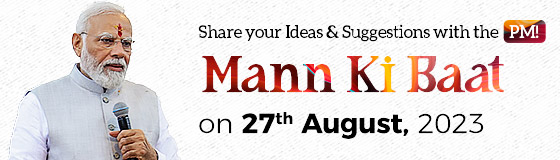
Inviting ideas for Mann Ki Baat by Prime Minister Narendra Modi on 27th August 2023

Start Date :
Aug 03, 2023
Last Date :
Aug 25, 2023
23:45 PM IST (GMT +5.30 Hrs)
Hon'ble PM Narendra Modi looks forward to sharing his thoughts on themes and issues that matter to you. Prime Minister invites you to share your ideas on topics he should address ...
All Comments
Featured
New Comments
Showing 5020 Submission(s)
Duraiswamy Lakshmanan
2 years 11 months ago
Unless and until you talk in the coming (27/08/2023) Mann-Ki-batt speech nobody will adopt FBCCA in their daily routine work, to reduce the GHG emission load up to 320 kgs per person per year.
Family Based Climate change Actions (FBCCA) is the experimentally proven practices (5R) that mainly address a) to REDUCE the Electrical power consumption b) to REUSE the wastewater, c) to REJECT the use of SUP (Single Use Plastic) d) to REGAIN the natural gas consumption and e) to RIDDEN the traffic flow. JAIHIND
Like
(6)
Dislike
(0)
Reply
Report Spam
SHASHIKANT CHAUBEY
2 years 11 months ago
UDAN 4.1
Ude Desh Ka Aam Naagrik (UDAN) was launched as a regional connectivity scheme in 2016.
It aims to create affordable yet economically viable and profitable flights on regional routes so that flying becomes affordable to the common man even in small towns.
UDAN 4.1 focuses on connecting smaller airports, along with special helicopter and seaplane routes.
It is an initiative of the Ministry of Civil Aviation (MoCA).
Like
(6)
Dislike
(0)
Reply
Report Spam
SHASHIKANT CHAUBEY
2 years 11 months ago
PM KISAN
Under the scheme, the Centre transfers an amount of Rs 6,000 per year directly into the bank accounts of all landholding farmers.
It is a Central Sector Scheme and is being implemented by the Ministry of Agriculture and Farmers Welfare.
The beneficiary identification is done by the State / UT Governments.
PM-KISAN Mobile App: It is developed and designed by the National Informatics Centre in collaboration with the MeitY.
It facilitates the farmers to view the status of their application and check the history of credits to their bank accounts.
Like
(6)
Dislike
(0)
Reply
Report Spam
SHASHIKANT CHAUBEY
2 years 11 months ago
Kisan Credit Card (KCC)
The scheme was introduced to provide adequate and timely credit support to the farmers for their cultivation and agricultural purchases.
KCC covers post-harvest expenses, consumption requirements of farmer households, investment credit requirements for agriculture and allied activities etc.
KCC is implemented by Commercial Banks, RRBs, Small Finance Banks and Cooperatives.
The KCC saturation campaign provides KCC loans to farmers who have not been given such loans.
It comes with an ATM-enabled RuPay debit card for any number of drawals within the limit.
Like
(6)
Dislike
(0)
Reply
Report Spam
SHASHIKANT CHAUBEY
2 years 11 months ago
e-Commerce
It is a business model that lets firms and individuals buy and sell things over the Internet.
India’s e-commerce revenue is growing at an annual rate of 51%, the highest in the world.
The Indian e-commerce market is expected to grow to US$ 200 billion by 2026.
Government Initiatives regarding e-Commerce in India:
Draft e-commerce rules, 2021
RBI permitted interoperability among Prepaid Payment Instruments (PPIs) such as digital wallets
Government e-Marketplace (GEM).
Like
(6)
Dislike
(0)
Reply
Report Spam
SHASHIKANT CHAUBEY
2 years 11 months ago
Cooperative Movement in India
The Cooperative Movement in India began in the last quarter of the 19th century.
Several informal cooperatives existed by the names of Devarai, Chit Funds, Kuries, Bhishies, Phads etc.
The first Cooperative Credit Societies Act was passed in 1904 and was later amended by the Cooperative Societies Act, 1912.
Mahatma Gandhi introduced the 'Phoenix Settlement' as a cooperative in a socialistic pattern and the Tolstoy Farm as a rehabilitation cooperative settlement.
After independence, cooperatives became an integral part of Five-Year Plans (FYPs).
Constitutional Provisions:
The Constitution (97th Amendment) Act, 2011 added a new Part IXB right after Part IXA (Municipals) regarding the cooperatives working in India.
The word “cooperatives” was added after “unions and associations” in Article 19(1)(c) under Part III of the Constitution.
Like
(6)
Dislike
(0)
Reply
Report Spam
SHASHIKANT CHAUBEY
2 years 11 months ago
India should look to adopt the Gandhian approach of balancing economic benefits with sustainability for meeting the broader goals of growth, employment generation, equity and protection of environment.
India must focus on marine ICTs, and transport (shipping) and communication services, and the creation of a knowledge hub for marine research and development.
An effective response mechanism to address humanitarian crises and natural disasters should be made for the evolving Indian Ocean security strategy.
India should not look at its oceans as just water bodies, but as global stage for continued economic, social, and cultural dialogue.
With its vast maritime interests, the blue economy occupies a vital potential position in India’s economic growth.
It could well be the next multiplier of GDP and well-being, provided sustainability and socio-economic welfare are kept center-stage.
Like
(6)
Dislike
(0)
Reply
Report Spam
Rahul Khare
2 years 11 months ago
honrable pm of india please open AIIMS at khajuraho
Like
(6)
Dislike
(0)
Reply
Report Spam
SHASHIKANT CHAUBEY
2 years 11 months ago
The Sagarmala Programme was approved by the Union Cabinet in 2015 which aims at holistic port infrastructure development along the 7,516-km long coastline through modernisation, mechanisation and computerisation.
The vision of the Sagarmala Programme is to reduce logistics costs for EXIM (Export-Import) and domestic trade with minimal infrastructure investment.
Sagarmala could boost India’s merchandise exports to USD 110 billion by 2025 and create an estimated 10 million new jobs (four million in direct employment).
The Ministry has started the ambitious Project of Sagarmala Seaplane Services (SSPS) with potential airline operators.
Like
(6)
Dislike
(0)
Reply
Report Spam
SHASHIKANT CHAUBEY
2 years 11 months ago
High Return on Investment: According to research commissioned by the high-level panel for a sustainable ocean economy shows that USD1 invested in key ocean activities yields five times i.e. USD5 in return, often more.
Synergy With SDG: It supports all of the United Nations’ Sustainable Development Goals (SDGs), especially SDG14 ‘life below water’.
Sustainable Energy: Supporting the increasing demand for renewable energy, offshore regions have tremendous potential in the form of offshore wind, waves, ocean currents including tidal currents, and thermal energy.
Like
(6)
Dislike
(0)
Reply
Report Spam
- View More