

Home | MyGov

Accessibility
Accessibility Tools
Color Adjustment
Text Size
Navigation Adjustment
Screen Reader iconScreen Reader

Inviting Ideas for Mann Ki Baat by Prime Minister Narendra Modi on 29th December 2024

Inviting Ideas for Mann Ki Baat by Prime Minister Narendra Modi on 29th December 2024
Start Date :
Dec 06, 2024
Last Date :
Dec 27, 2024
23:45 PM IST (GMT +5.30 Hrs)
Submission Closed

Hon'ble PM Narendra Modi looks forward to sharing his thoughts on themes and issues that matter to you. Prime Minister invites you to share your ideas on topics he should address ...

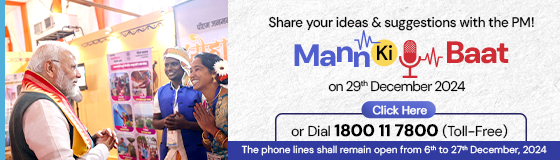
Hon'ble PM Narendra Modi looks forward to sharing his thoughts on themes and issues that matter to you. Prime Minister invites you to share your ideas on topics he should address on the 117th Episode of Mann Ki Baat.

Send us your suggestions on the themes or issues you want the Prime Minister to speak about in the upcoming Mann Ki Baat episode. Share your views in this Open Forum or alternatively, you can also dial the toll-free number 1800-11-7800 and record your message for the Prime Minister in either Hindi or English. Some of the recorded messages may become part of the broadcast.

You can also give a missed call on 1922 and follow the link received in SMS to directly give your suggestions to the Prime Minister.

And stay tuned to Mann Ki Baat at 11:00 AM on 29th December 2024.

Reset
Showing 7459 Submission(s)
Bisathi Bharath
Bisathi Bharath 1 year 8 months ago
NGOs point to the fact that the real spike in child labour is yet to come. When economic activity begins accelerating, there is a risk of returning migrants taking children along with them to the cities. Children’s access to education, basic nutrition and other critical requirements for their development and wellbeing, have suffered a huge setback and many new children have fallen into the trap of forced labour along with further deteriorated conditions for the existing child labourers. Incoherency between laws that prescribe a minimum age for employment and those for completion of compulsory school education. It also means that the expansion of quality universal basic education has to extend beyond the fulfilment of statutory provisions.
Bisathi Bharath
Bisathi Bharath 1 year 8 months ago
Challenges before policy makers with respect to child labour Definitional issue: One of the biggest challenges in eradicating child labour is the confusion around the definition of a child, in terms of age, in various laws dealing with child labour. Lack of identification: Age identification of children is a difficult task in India due to the lack of identification documents. Child labourers often lack school registration certificates and birth certificates, creating an easy loophole in the law to exploit. Most often the children of migrant workers working as labourers and those employed in domestic work go unreported. Weak enforcement of law and poor governance: Weak enforcement of the law, lack of adequate deterrence and corruption is a major hurdle in eradicating child labour.
Bisathi Bharath
Bisathi Bharath 1 year 8 months ago
Orphaned children are particularly vulnerable to trafficking and other exploitation like forced begging, or child labour. In such families, there is also the likelihood of older children dropping out of school to support their younger siblings. Children are seen as a stop-gap measure to fill jobs left vacant by migrant labourers who fled cities for their rural homes during the lockdown. According to the CACL survey, more than 94% of children have said that the economic crisis at home and family pressure had pushed them into work. Most of their parents had lost their jobs or earned very low wages during the pandemic. A total of 591 children were rescued from forced work and bonded labour from different parts of India during the lockdown by Bachpan Bachao Andolan, a civil society group on children’s rights
Bisathi Bharath
Bisathi Bharath 1 year 8 months ago
In India, the closure of schools and the economic crisis faced by the vulnerable families, triggered by the pandemic, are likely drivers pushing children into poverty and thus, child labour and unsafe migration. There has been a significant increase in the proportion of working children from 28.2% to 79.6% out of the 818 children who were surveyed, mainly because of the COVID-19 pandemic and closure of schools, reveals a study conducted by Campaign Against Child Labour (CACL). The coronavirus pandemic is forcing India’s children out of school and into farms and factories to work, worsening a child-labour problem that was already one of the direst in the world.
Bisathi Bharath
Bisathi Bharath 1 year 8 months ago
Situation of Child Labour in India The number of children working as child labourers came down by 100 million in last two decades (1991 to 2011) which demonstrates that the right combination of policy and programmatic interventions can make a difference; but COVID-19 pandemic has undone a lot of gains The Covid-19 crisis has brought additional poverty to these already vulnerable populations and may reverse years of progress in the fight against child labour- ILO A report by the International Labour Organization (ILO) and UNICEF warns that 9 million additional children are at the risk of being pushed into child labour by the end of 2022 globally, as a result of the pandemic.
Bisathi Bharath
Bisathi Bharath 1 year 8 months ago
Impacts of child labour Affect childhood: Child labour takes away a child of his/her childhood. It not only denies his/her right to education but also right to leisure. Affect adult life: Child labour prevents children from gaining the skills and education they require to have opportunities for decent work when they become an adult. Major health and physical risks: as they work long hours and are needed to do tasks for which they are physically and mentally unprepared. Working in hazardous situations adversely impacts a child’s physical and mental health and affects intellectual, emotional and psychological development.
Bisathi Bharath
Bisathi Bharath 1 year 8 months ago
Digital divide’: Lack of access to the internet, Digital devices have forced challenges in distant learning and online learning for children. According to the NSS Report titled ‘Household Social Consumption on Education in India’ only 24% of Indian households had access to an Internet facility. Unorganised Sector Growth: Due to stringent labour laws, industries prefer to hire contractual labour than permanent hiring. Weak Laws: Laws are not updated according to the seriousness of the situation. Other reasons: increased economic insecurity, lack of social protection and reduced household income, children from poor households Children are being pushed into child labor.
Bisathi Bharath
Bisathi Bharath 1 year 8 months ago
actors leading to Child Labour Increase in ‘out of school’ children: UNESCO estimates that around 38.1 million children are “out of school”. Economic crisis: The economic contraction and lockdowns lead to income reductions for enterprises and workers, many of them in the informal economy. Socioeconomic Challenges: caused by the return of migrant workers has compounded the problem. Issues in the Indian Economy: India experienced slower economic growth and rising unemployment even before the pandemic.
Bisathi Bharath
Bisathi Bharath 1 year 8 months ago
ven though there was a decline in the number of working children to 3.9% in 2011 from 5% in 2001, the decline rate is grossly insufficient to meet target 8.7 of the UN Sustainable Development Goals (SDGs), which is to end child labour in all forms by 2025. India tops the list when it comes to the number of children still living and working in bonded labour and slave conditions. The side-effects of working at a young age are: Risks of contracting occupational diseases like skin diseases, diseases of the lungs, weak eyesight, TB etc.; Vulnerability to sexual exploitation at the workplace; Deprived of education. They grow up unable to avail development opportunities and end up as unskilled workers for the rest of their lives.
ASHOKKUMAR LAXMIDAS UNADKAT
ASHOKKUMAR LAXMIDAS UNADKAT 1 year 8 months ago
NEED DISCUSSION ON THALASSEMIA SCREENING BEFORE ENGAGEMENT/MARRIAGE. IN INDIA, APPX 10000 NEW BABIES BORN WITH THALASSEMIA-MAJOR WHICH IS HORRIBLE SITUATION FOR CHILDREN AND PARENTS. SCREENING BEFORE MARRIAGE AND AWARENESS CAN PREVENT MANY THALASSEMIC CHILDREN.