Home | MyGov

Accessibility
Accessibility Tools
Color Adjustment
Text Size
Navigation Adjustment
Screen Reader iconScreen Reader

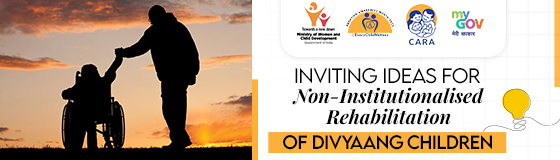
Inviting Ideas for Non-Institutionalised Rehabilitation of Divyaang Children

Inviting Ideas for Non-Institutionalised Rehabilitation of Divyaang Children
Start Date :
Oct 01, 2025
Last Date :
Nov 30, 2025
17:30 PM IST (GMT +5.30 Hrs)
Submission Closed

In 2025, the Central Adoption Resource Authority (CARA) is placing special focus on promoting family-based care for children with special needs (Divyaang children). In ...

In 2025, the Central Adoption Resource Authority (CARA) is placing special focus on promoting family-based care for children with special needs (Divyaang children). In collaboration with MyGov, CARA invites all Indian citizens to participate in an important national discussion on the theme:
“Non-institutionalized Rehabilitation of Children with Special Needs (Divyaang Children)”

This initiative seeks to create a collaborative platform where citizens can:
1. Share insights on the challenges and barriers in the identification and adoption of children with special needs
2. Suggest innovative ideas, strategies, or solutions to strengthen the adoption ecosystem
3. Contribute to policy-making by offering actionable recommendations to ensure a loving family environment for every child, especially those currently residing in Specialized Adoption Agencies (SAAs) and Child Care Institutions (CCIs)

Your thoughtful suggestions can play a key role in shaping a more inclusive, compassionate, and efficient adoption framework for Divyaang children.

Who can participate?
All Indian citizens are welcome to join the conversation and submit their ideas.

Why participate?
Selected entries may be featured in national-level publications, exhibitions, and even considered in policy discussions aimed at improving the lives of children with special needs.

Let’s work together to ensure every child finds a loving family and a brighter future. Join the discussion today and be a voice for change!

Reset
Showing 777 Submission(s)
subodh bansal
subodh bansal 7 months 3 weeks ago
My post no. 38 autism and ADHD treatment  https://www.facebook.com/share/r/1NP67DiGM1/ Blindness treatment  https://www.facebook.com/share/r/1LyH6vzuM6/ Speech clinic  https://www.facebook.com/reel/800069939135394/?mibextid=9drbnH&s=yWDuG2&fs=e please read my all posts.
subodh bansal
subodh bansal 7 months 3 weeks ago
My post no. 38 autism and ADHD treatment  https://www.facebook.com/share/r/1NP67DiGM1/ Blindness treatment  https://www.facebook.com/share/r/1LyH6vzuM6/ Speech clinic  https://www.facebook.com/reel/800069939135394/?mibextid=9drbnH&s=yWDuG2&fs=e please read my all posts.
DR SWAPNIL MANTRI
DR SWAPNIL MANTRI 7 months 3 weeks ago
After-School Inclusive Learning Centers Community-based small centers (2–3 hours). Provide one-on-one support, behaviour management, and social skills training. Run by trained volunteers/NGOs. Life-Skills & Daily Living Training Cooking basics, grooming, money handling, social rules, safety skills. Can be taught in home environments for real-life learning. Faith-Based & NGO Partnerships Use temple/gurudwara/church halls as low-cost therapy spaces. Volunteer therapists and retired teachers can contribute time.
DR SWAPNIL MANTRI
DR SWAPNIL MANTRI 7 months 3 weeks ago
Mobile Therapy Van / Travelling Rehab Clinic Physiotherapist + speech therapist + special educator visiting each village weekly. On-the-spot therapy, device fitting, parent training. Very effective where services are lacking. Local Accessibility Improvements Ramps in homes, community centres, and schools. Low-cost mobility aids made locally (walkers, modified tricycles). Toilet modifications for safety and independence. Parent Support & Empowerment Groups Awareness on rights, government schemes, and therapy techniques. Emotional support platforms (offline/WhatsApp groups). Helps ensure continuity of care at home.
DR SWAPNIL MANTRI
DR SWAPNIL MANTRI 7 months 3 weeks ago
Skill-Building & Pre-Vocational Activities (For older children) Basic computer skills Tailoring, craft, candle/agarbatti making Gardening, nursery work Digital literacy Can be taught in local community halls or homes. Volunteer “Buddy System” One local college student paired with a divyang child. Helps with homework, communication, outings, and play. Strengthens inclusion and reduces family burden. Inclusive Education Support Train school teachers for learning adjustments. Provide home-based remedial teaching. Peer-learning groups in neighbourhoods. Mobile teaching units for remote villages.
DR SWAPNIL MANTRI
DR SWAPNIL MANTRI 7 months 3 weeks ago
Small groups of 5–10 families with divyang children meet weekly. Activities: shared therapy sessions, play-based learning, mobility practice, inclusive games. Led by an Anganwadi worker, ASHA, or trained volunteer. Train parents to carry out simple physiotherapy, speech exercises, and behavioural techniques. Provide digital support videos in local language. Door-to-door visits by therapists (monthly/bi-monthly). Use tablets/phones with apps for communication, speech therapy, cognitive games. Virtual therapy sessions for children in remote areas. AI-based tools for learning disability support. Weekly community clubs for: Art and craft Music therapy Dance movement therapy Inclusive sports (Boccia, seated football, adapted cricket) Builds confidence and social interaction.
Giriraj
Giriraj 7 months 3 weeks ago
Incentivize SAAs: Recognize and reward agencies that consistently place children with special needs efficiently and provide quality post-adoption support.
gulfan
gulfan 7 months 3 weeks ago
Non-Institutionalised Rehabilitation Ideas for Divyang Children 1. Community-Based Rehabilitation (CBR) Hubs Small, local centres—run in schools, panchayat buildings, or community halls—offering: Physiotherapy and occupational therapy visits once/twice a week Speech therapy sessions Basic assistive device repair support Parent guidance workshops These hubs reduce the burden of travel and keep care within the community. 2. Parent-Led Home-Based Therapy Programs Train parents through simple modules: Daily home exercises for motor skills Communication and behaviour training routines Sensory integration activities using household items (balls, rice, sand, swings) Visual schedules for children with autism Regular tele-consultation with specialists can support families. 3. Inclusive Neighbourhood Learning Circles Small groups of children (with and without disabilities) gather for: Storytelling, art, music Peer learning and cooperative play Social skill-building activities The
Shinde Supriya Prakash
Shinde Supriya Prakash 7 months 3 weeks ago
Isme divyang bachchon ke liye behtar care system par sujhav mangey jaate hain. Likhe: Inclusive schools Early diagnosis centres Free therapy support (speech/occupational therapy) Parents counseling system Transportation support Example: “Har district mein ek Early Intervention Centre hona chahiye jahan free physiotherapy, speech therapy aur counseling mil sake.”