Home | MyGov

Accessibility
Accessibility Tools
Color Adjustment
Text Size
Navigation Adjustment
Screen Reader iconScreen Reader

Inviting Suggestions on the Draft 5th National Science, Technology, and Innovation Policy

Start Date :
Jan 10, 2021
Last Date :
Jan 25, 2021
23:45 PM IST (GMT +5.30 Hrs)
Submission Closed

Release of Draft 5th National Science, Technology, and Innovation Policy for public consultation ...

Release of Draft 5th National Science, Technology, and Innovation Policy for public consultation

As India and the world reorient in the present context of the COVID-19 crisis, a new Science, Technology, and Innovation Policy (STIP) was initiated at this crucial juncture during mid-2020. For India to march ahead on a sustainable development pathway to include economic development, social inclusion and environmental sustainability for achieving an Atmanirbhar Bharat'', a greater emphasis may be needed on promoting traditional knowledge systems, developing indigenous technologies and encouraging grassroots innovations. The emergence of disruptive and impactful technologies poses new challenges and simultaneously greater opportunities. The COVID-19 pandemic provided a compelling opportunity for R&D institutions, academia and industry to work in unison for sharing of purpose, synergy, collaboration and cooperation.

The new Science, Technology, and Innovation Policy aims to bring about profound changes through short-term, medium-term, and long-term mission mode projects by building a nurtured ecosystem that promotes research and innovation on the part of both individuals and organizations. It aims to foster, develop, and nurture a robust system for evidence and stakeholder-driven STI planning, information, evaluation, and policy research in India. The objective of the policy is to identify and address the strengths and weaknesses of the Indian STI ecosystem to catalyse socio-economic development of the country and also make the Indian STI ecosystem globally competitive.

The new policy, STIP, revolves around the core principles of being decentralized, evidence-informed, bottom-up, experts-driven, and inclusive. Also, it aims to bring in the concept of dynamic policy with a robust policy governance mechanism incorporating features such as implementation strategy, periodic review, policy evaluation, feedback, and adaptation, and most importantly, a timely exit strategy for various policy instruments.
Keeping above in view, a STIP policy document ver 1.4 has been finalized and placed here after a detailed 4 track process of consultations during last 6 months beginning from May 2020. The process so far involved nearly 300 rounds of consultations with more than 40,000 stakeholders well distributed in terms of region, age, gender, education, economic status, etc. The STIP Secretariat was coordinated, supported, and guided by the Office of PSA, NITI Aayog, and DST. The formulation process, by design, envisioned as a very inclusive and participative model with intense interconnectedness among different tracks of activities.

Your suggestions, inputs and comments on the draft STIP will be invaluable towards finalization of the policy document. We shall be grateful if you could find time to go through this draft and share your thoughts on the proposed STI policy latest by Monday the 25th January 2021 on email: india-stip[at]gov[dot]in

Click here to read the draft.

Reset
Showing 983 Submission(s)
Harshdeep Kour
Harshdeep Kour 5 years 5 months ago
Keeping above in view, a STIP policy document ver 1.4 has been finalized and placed here after a detailed 4 track process of consultations during last 6 months beginning from May 2020. The process so far involved nearly 300 rounds of consultations with more than 40,000 stakeholders well distributed in terms of region, age, gender, education, economic status, etc. The STIP Secretariat was coordinated, supported, and guided by the Office of PSA, NITI Aayog, and DST. The formulation process, by des
Harshdeep Kour
Harshdeep Kour 5 years 5 months ago
we require and import a number of high purity materials. we have the capability to produce. Presently the cost of production may be on higher side as quantity required is small. But, it is essential to develop the technology further, rather than allowing it to die and then depend on other countries to meet the requirements.
Khushi
Khushi 5 years 5 months ago
as India and the world and reorient in the present content of the covid-19 cricis a new science Technology and innovation Policy was indicated at their crucial junicture during Mid 2020 for India to March ahead on a sustainable development pathway to include economic development social inclusion and environmental sustainabilityfor achieving at aatm nirbhar Bharat a greater emphasis may be needed on promoting traditional knowledge system. developing indigenous download Technologies .
Harshdeep Kour
Harshdeep Kour 5 years 5 months ago
make it more useful in daily life.more practicl implementation. I think japan can help with it. their school level education and our resources 2gether bring something new nd useful.bcuz what we r teaching in schools nd colleges has no industrial implementation. from class 6th oneards 1month of summer vacation focus on what students should choose till 10th they can have enough understanding. we don't have any clue how to be ias,ipso any civil servant bcuz we don't know anything
Harshdeep Kour
Harshdeep Kour 5 years 5 months ago
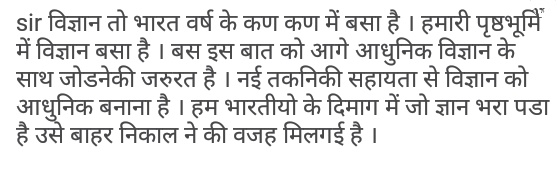
sir विज्ञान तो भारत वर्ष के कण कण में बसा है । हमारी पृष्ठभूमि में विज्ञान बसा है । बस इस बात को आगे आधुनिक विज्ञान के साथ जोडनेकी जरुरत है । नई तकनिकी सहायता से विज्ञान को आधुनिक बनाना है । हम भारतीयो के दिमाग में जो ज्ञान भरा पडा है उसे बाहर निकाल ने की वजह मिलगई है ।
Harshdeep Kour
Harshdeep Kour 5 years 5 months ago
The new Science, Technology, and Innovation Policy aims to bring about profound changes through short-term, medium-term, and long-term mission mode projects by building a nurtured ecosystem that promotes research and innovation on the part of both individuals and organizations. It aims to foster, develop, and nurture a robust system for evidence and stakeholder-driven STI planning, information, evaluation, and policy research in India.
Harshdeep Kour
Harshdeep Kour 5 years 5 months ago
The objective of the policy is to identify and address the strengths and weaknesses of the Indian STI ecosystem to catalyse socio-economic development of the country and also make the Indian STI ecosystem globally competitive. The new policy, STIP, revolves around the core principles of being decentralized, evidence-informed, bottom-up, experts-driven, and inclusive.