Home | MyGov

Accessibility
Accessibility Tools
Color Adjustment
Text Size
Navigation Adjustment
Screen Reader iconScreen Reader

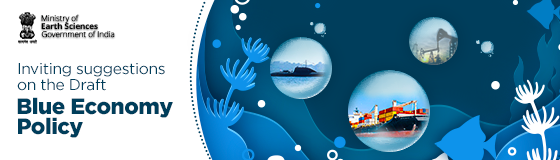
Inviting Suggestions on the Draft Blue Economy Policy

Inviting Suggestions on the Draft Blue Economy Policy
Start Date :
Feb 19, 2021
Last Date :
Feb 27, 2021
23:45 PM IST (GMT +5.30 Hrs)
Submission Closed

With a coastline of nearly 7.5 thousand kilometres, India has a unique maritime position. Nine of its 29 states are coastal, and the nation’s geography includes 1,382 islands. ...

With a coastline of nearly 7.5 thousand kilometres, India has a unique maritime position. Nine of its 29 states are coastal, and the nation’s geography includes 1,382 islands. There are nearly 199 ports, including 12 major ports that handle approximately 1,400 million tons of cargo each year. Moreover, India’s Exclusive Economic Zone of over 2 million square kilometres has a bounty of living and non-living resources with significant recoverable resources such as crude oil and natural gas. Also, the coastal economy sustains over 4 million fisherfolk and coastal communities. With these vast maritime interests, the blue economy occupies a vital potential position in India’s economic growth. It could well be the next multiplier of GDP and well-being, provided sustainability and socio-economic welfare are kept centre-stage. Therefore, India's draft blue economy policy is envisaged as a crucial framework towards unlocking country’s potential for economic growth and welfare.

The MoES prepared the draft blue economy policy framework in line with the Government of India’s Vision of New India by 2030. It highlighted the blue economy as one of the ten core dimensions for national growth. The draft policy framework emphasizes policies across several key sectors to achieve holistic growth of India’s economy. The document recognizes the following seven thematic areas.

1.National accounting framework for the blue economy and ocean governance.
2.Coastal marine spatial planning and tourism.
3.Marine fisheries, aquaculture, and fish processing.
4.Manufacturing, emerging industries, trade, technology, services, and skill development.
5.Logistics, infrastructure and shipping, including trans-shipments.
6.Coastal and deep-sea mining and offshore energy.
7.Security, strategic dimensions, and international engagement.

The Ministry of Earth Sciences (MoES) has rolled out the Draft Blue Economy policy for India by Inviting suggestions and inputs from various stakeholders including industry, NGOs, academia, and citizens. The draft blue economy policy document outlines the vision and strategy that can be adopted by the Government of India to utilize the plethora of oceanic resources available in the country.

Click here to read the Draft Blue Economy Policy.

Reset
Showing 487 Submission(s)
Jane Alam
Jane Alam 5 years 2 months ago
Indian company have to do more innovation in technologies and in defence and make strict laws for people and also make laws on environment. We have to support India always. Atmanirbhar Bharat💪💪💪. We have to make budget in more innovation in India on technology sectore and not give china to permission to manufacture in India. Make budget on indian company. We have to do mare innovation in gaming sectors in India, also make own operating system for mobiles and computers and permote them.
Jane Alam
Jane Alam 5 years 2 months ago
It is difficult to understand that with 7.5 Km of coast line and 1382 islands, why India is nowhere in beach tourism whereas economies of several countries with much less coast line and island nations with no other activities are surviving on beach tourism alone. One reason which I have witnessed is because mainland coast line beaches are too crowded and infested with hawkers and vendors that there is no privacy and one can not really just watch the beauty of sea and enjoy the nature.
ARUN KUMAR GUPTA
ARUN KUMAR GUPTA 5 years 2 months ago
Our mainland coast line has many advantages. Innumerable tourist spots are there from beauties of Rann of Kutch, historic city of Dwarka, Western Ghats, Golden beaches of Kerala, bottom most tip of India Kanyakumari, Rameshwaram, Puri, Sunderbans which offer natural, historic, spiritual tourism. It only require entrepreneurship to make these big tourism destinations.
ARUN KUMAR GUPTA
ARUN KUMAR GUPTA 5 years 2 months ago
There would be many inhabited islands which would have been taken over by miscreants and must be operating some illegal activities. If the remote islands have people movements from mainland, there would be development of not only tourism but would improve island infrastructure. Government would have better administrative control over these islands
ARUN KUMAR GUPTA
ARUN KUMAR GUPTA 5 years 2 months ago
There would be many islands which may be thinly populated. Some of these islands which are not strategically significant from defence point of view can be given on lease to some good hotel chains to develop as tourism destinations. Being away from mainland, these may offer better privacy to foreign tourists.
ARUN KUMAR GUPTA
ARUN KUMAR GUPTA 5 years 2 months ago
We have many inhibitions and social stigma which prevents tourists to enjoy our beaches. We see the pictures of foreign beaches where people walk or enjoy sunshine in very less clothes. Can any of our beach give this liberty? There is a solution that we can give the beaches on lease to tour operators. There they can give the freedom to tourists to enjoy the beach as they like without any disturbance from petty vendors or unruly Indian crowd.
ARUN KUMAR GUPTA
ARUN KUMAR GUPTA 5 years 2 months ago
It is difficult to understand that with 7.5 Km of coast line and 1382 islands, why India is nowhere in beach tourism whereas economies of several countries with much less coast line and island nations with no other activities are surviving on beach tourism alone. One reason which I have witnessed is because mainland coast line beaches are too crowded and infested with hawkers and vendors that there is no privacy and one can not really just watch the beauty of sea and enjoy the nature.