Home | MyGov

Accessibility
Accessibility Tools
Color Adjustment
Text Size
Navigation Adjustment
Screen Reader iconScreen Reader

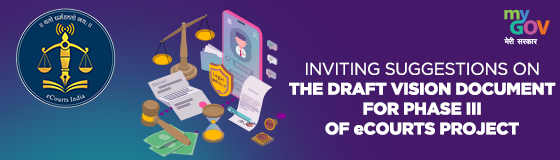
Inviting suggestions on the Draft Vision document for Phase III of eCourts Project

Start Date :
Apr 08, 2021
Last Date :
May 31, 2021
23:45 PM IST (GMT +5.30 Hrs)
Submission Closed

The e-Committee of the Supreme Court has been overseeing the implementation of the e-Courts Project, conceptualized under the "National Policy and Action Plan for Implementation of ...

The e-Committee of the Supreme Court has been overseeing the implementation of the e-Courts Project, conceptualized under the "National Policy and Action Plan for Implementation of Information and Communication Technology (ICT) in the Indian Judiciary-2005". It is the mission mode project carried out by the Department of Justice.

The e-Committee has evolved in terms of its roles and responsibilities over the last fifteen years. The objectives of the e-Committee include:
The Interlinking of all courts across the country.
ICT enablement of the Indian judicial system.
Enhancing judicial productivity.
Making the justice delivery system accessible, cost-effective, transparent, and accountable.
Providing citizen-centric services.

As Phase-II will soon conclude, the draft vision document for Phase III is prepared. This draft Vision Document outlines an inclusive, agile, open, and user-centric vision for courts in Phase III of the e-Courts Project.

Phase III envisions digital courts that deliver justice as a service to all, beyond simply replicating offline processes digitally. The use of technology in the judiciary is therefore guided by two facets central to Gandhian thought—access and inclusion. In addition, the core values of trust, empathy, sustainability, and transparency provide the guardrails for achieving the founding vision.

Building over the advancements made in Phases I & II of the project, this document articulates the need to exponentially advance the digitization of courts by (a) simplifying procedures, (b) creating a digital infrastructure, and the (c) establishment of the right institutional and governance framework, such as technology offices at various levels to enable the judiciary to appropriately employ technology. It articulates key goals for putting in place the digital infrastructure and services for Phase III.

This vision document envisions a platform architecture for technology that will enable diverse digital services to further evolve over time at scale. It also is designed to take an ecosystem approach that leverages the existing capacities in different stakeholders such as civil society leaders, universities, practitioners, and technologists to realise this future.

The e-Committee, Supreme Court of India has called for comments, suggestions, and inputs on the draft vision document for its 3rd phase of the e-Courts Project from all its stakeholders to refine and plan the implementation of the next phase of the e-Courts Project.

Click here to read the Draft Vision Document.

The last date to receive inputs is 31st May 2021.

Reset
Showing 1705 Submission(s)
SATHYAMOORTI I
SATHYAMOORTI I 5 years 3 months ago
Provide online facility to apply for certified copies of very old verdicts online with facility to pay the fee online. Publish the minimum fee prescribed for various legal services extended by the advocates as recommended by the committee and publish it on website
Swetha Kannan
Swetha Kannan 5 years 3 months ago
4.Localising or changing to other pkaces cases in possible ways. 5. Definitely computerising or cases can be logged and followup are easy, intranet will help in cases to transfer data within courts , with required data security.
Swetha Kannan
Swetha Kannan 5 years 3 months ago
2. Small cases can complete with stipulated timeline. Counselling can be given to become unite both the parties in possible cases. 3. Lawers should not extend the cases, they should not be money minded or trying to complete the cases small issues or possible issues.
Swetha Kannan
Swetha Kannan 5 years 3 months ago
General suggestions 1. As per my knowledge related to asset cases judges can complete within 5 to 10 years. Sone cases going 30 years. 30 active years means 1 generation. Lawer getting money from both the parties. This is happening my known circle. The parties have not going smooth, lawer getting money both the parties, cases happening 30 to 35 years. This is reallyno productivity for anyone. Tine, energy and money waste. Something need to do , to complete this kind of cases.
Laxmi Prakash Semwal
Laxmi Prakash Semwal 5 years 3 months ago
Phase third vision document highlights the enabling ecosystem to achieve timely justice and speedy processing of cases with transparent digital spaces. Reforms in judiciary will eventually give more equality to citizens.
Shubham Pandey
Shubham Pandey 5 years 3 months ago
माननीय प्रधानमंत्री नरेन्द्र मोदी जी... इस दुःख की घड़ी में सबसे पहले हम सभी देशवासियों का एक ही कर्त्तव्य बनता है कि हम लोग घर मे रहे सुरक्षित रहे और कानून के नियमों का पालन करे। और जानता का सहयोग करे उनसे भेदभाव ना करे। आये दिन ये सुने में आता है कि जब किसी का करोना से मृत्यु हो रही है तो लोग ऐसे बार्तव्य कर रहे जिसे शब्दो मे बया नही करा जा सकता है। पहले हम सभी देश के लोगो का कर्तव्य है की हम एक साथ काम ले और देश को पहले की तरफ फिर स्वच्छ भारत बनाये।