Home | MyGov

Accessibility
Accessibility Tools
Color Adjustment
Text Size
Navigation Adjustment
Screen Reader iconScreen Reader

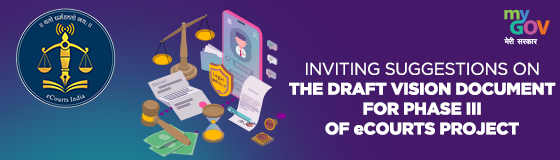
Inviting suggestions on the Draft Vision document for Phase III of eCourts Project

Start Date :
Apr 08, 2021
Last Date :
May 31, 2021
23:45 PM IST (GMT +5.30 Hrs)
Submission Closed

The e-Committee of the Supreme Court has been overseeing the implementation of the e-Courts Project, conceptualized under the "National Policy and Action Plan for Implementation of ...

The e-Committee of the Supreme Court has been overseeing the implementation of the e-Courts Project, conceptualized under the "National Policy and Action Plan for Implementation of Information and Communication Technology (ICT) in the Indian Judiciary-2005". It is the mission mode project carried out by the Department of Justice.

The e-Committee has evolved in terms of its roles and responsibilities over the last fifteen years. The objectives of the e-Committee include:
The Interlinking of all courts across the country.
ICT enablement of the Indian judicial system.
Enhancing judicial productivity.
Making the justice delivery system accessible, cost-effective, transparent, and accountable.
Providing citizen-centric services.

As Phase-II will soon conclude, the draft vision document for Phase III is prepared. This draft Vision Document outlines an inclusive, agile, open, and user-centric vision for courts in Phase III of the e-Courts Project.

Phase III envisions digital courts that deliver justice as a service to all, beyond simply replicating offline processes digitally. The use of technology in the judiciary is therefore guided by two facets central to Gandhian thought—access and inclusion. In addition, the core values of trust, empathy, sustainability, and transparency provide the guardrails for achieving the founding vision.

Building over the advancements made in Phases I & II of the project, this document articulates the need to exponentially advance the digitization of courts by (a) simplifying procedures, (b) creating a digital infrastructure, and the (c) establishment of the right institutional and governance framework, such as technology offices at various levels to enable the judiciary to appropriately employ technology. It articulates key goals for putting in place the digital infrastructure and services for Phase III.

This vision document envisions a platform architecture for technology that will enable diverse digital services to further evolve over time at scale. It also is designed to take an ecosystem approach that leverages the existing capacities in different stakeholders such as civil society leaders, universities, practitioners, and technologists to realise this future.

The e-Committee, Supreme Court of India has called for comments, suggestions, and inputs on the draft vision document for its 3rd phase of the e-Courts Project from all its stakeholders to refine and plan the implementation of the next phase of the e-Courts Project.

Click here to read the Draft Vision Document.

The last date to receive inputs is 31st May 2021.

Reset
Showing 1705 Submission(s)
MadangopalJha
MadangopalJha 5 years 1 month ago
The casual, emergency, planned leave plan of the Hon’ble judges should be made public on e courts well in advance so that it will help litigants traveling from other state. Such litigant’s status should be marked present in the court if Hon’ble Judge is absent.
Akash Agrawal
Akash Agrawal 5 years 1 month ago
1. There should be hearing for all possible cases through video conference link and those which are pending for mere formality purpose should be disposed off at earliest. 2. All court related documents should be made available to all parties through online portal and allowed to download their respective cases. 3. It should be allowed to continue this practice of online hearing even after physical hearing started, it will have its cascading benefits and speedy resolution in pending matters.
VikasBorikar
VikasBorikar 5 years 1 month ago
6. The casual, emergency, planned leave plan of the Hon’ble judges should be made public on ecourts well in advance so that it will help litigants traveling from other state. Such litigant’s status should be marked present in the court if Hon’ble Judge is absent. 7. NRI applicants/ Respondents should get default opportunity to have trial through video conference.
MadangopalJha
MadangopalJha 5 years 1 month ago
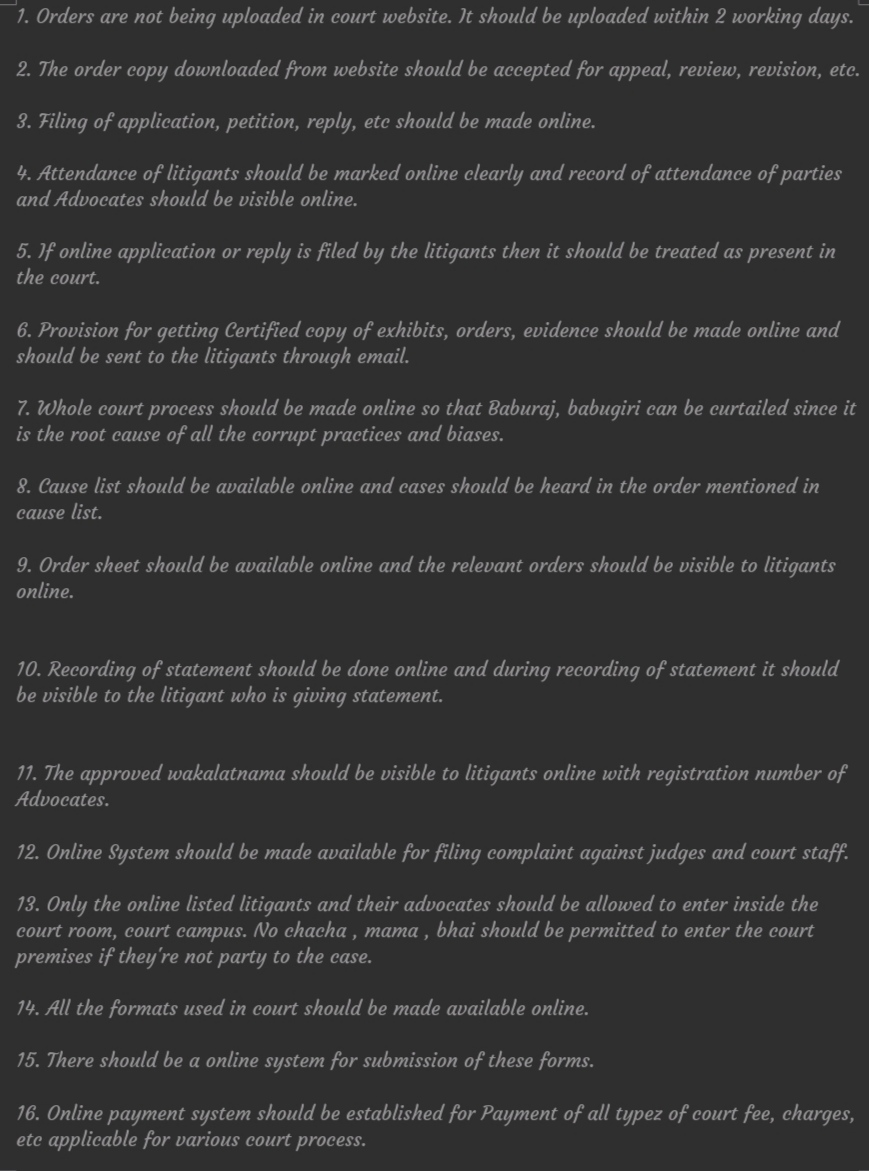
14. All the formats used in court should be made available online. 15. There should be a online system for submission of these forms. 16. Online payment system should be established for Payment of all typez of court fee, charges, etc applicable for various court process.
VikasBorikar
VikasBorikar 5 years 1 month ago
4. All judgements of the Hon’ble high courts and Hon’ble Supreme courts should be available on ecourts and accessible to public to ensure the transparency. 5. Applicant, respondents & witness’s cross examination recording of statement should be done online. The fair opportunity should be given to litigants to view the recorded statements on same day and it must be corrected if the statements are wrongly recorded.
MadangopalJha
MadangopalJha 5 years 1 month ago
12. Online System should be made available for filing complaint against judges and court staff. 13. Only the online listed litigants and their advocates should be allowed to enter inside the court room, court campus. No chacha , mama , bhai should be permitted to enter the court premises if they're not party to the case. 14. All the formats used in court should be made available online. 15. There should be a online system for submission of these forms.
VikasBorikar
VikasBorikar 5 years 1 month ago
1. Litigants should be allowed to file petition, reply, application online. This must be done with secured online authentication procedure so that it cannot be misused. 2. Certificated copy of the petitions, submitted replies, application should be made available online with digital signature and should be emailed to applicant only or upload on portal visible to applicant only. 3.Interim & final order must be uploaded on the ecourts website within considerable time like within working 2 days
MadangopalJha
MadangopalJha 5 years 1 month ago
8. Cause list should be available online and cases should be heard in the order mentioned in cause list. 9. Order sheet should be available online and the relevant orders should be visible to litigants online. 10. Recording of statement should be done online and during recording of statement it should be visible to the litigant who is giving statement. 11. The approved wakalatnama should be visible to litigants online with registration number of Advocates.
MadangopalJha
MadangopalJha 5 years 1 month ago
5. If online application or reply is filed by the litigants then it should be treated as present in the court. 6. Provision for getting Certified copy of exhibits, orders, evidence should be made online and should be sent to the litigants through email. 7. Whole court process should be made online so that Baburaj, babugiri can be curtailed since it is the root cause of all the corrupt practices and biases.
MadangopalJha
MadangopalJha 5 years 1 month ago
1. Orders are not being uploaded in court website. It should be uploaded within 2 working days. 2. The order copy downloaded from website should be accepted for appeal, review, revision, etc. 3. Filing of application, petition, reply, etc should be made online. 4. Attendance of litigants should be marked online clearly and record of attendance of parties and Advocates should be visible online.
mygov_162177438888866631