
- Chandigarh UT
- Creative Corner
- Dadra Nagar Haveli UT
- Daman and Diu U.T.
- Department of Administrative Reforms and Public Grievances
- Department of Biotechnology
- Department of Commerce
- Department of Consumer Affairs
- Department of Industrial Policy and Promotion (DIPP)
- Department of Posts
- Department of Science and Technology
- Department of Telecom
- Digital India
- Economic Affairs
- Ek Bharat Shreshtha Bharat
- Energy Conservation
- Expenditure Management Commission
- Food Security
- Gandhi@150
- Girl Child Education
- Government Advertisements
- Green India
- Incredible India!
- India Textiles
- Indian Railways
- Indian Space Research Organisation - ISRO
- Job Creation
- LiFE-21 Day Challenge
- Mann Ki Baat
- Manual Scavenging-Free India
- Ministry for Development of North Eastern Region
- Ministry of Agriculture and Farmers Welfare
- Ministry of Chemicals and Fertilizers
- Ministry of Civil Aviation
- Ministry of Coal
- Ministry of Corporate Affairs
- Ministry of Culture
- Ministry of Defence
- Ministry of Earth Sciences
- Ministry of Education
- Ministry of Electronics and Information Technology
- Ministry of Environment, Forest and Climate Change
- Ministry of External Affairs
- Ministry of Finance
- Ministry of Health and Family Welfare
- Ministry of Home Affairs
- Ministry of Housing and Urban Affairs
- Ministry of Information and Broadcasting
- Ministry of Jal Shakti
- Ministry of Law and Justice
- Ministry of Micro, Small and Medium Enterprises (MSME)
- Ministry of Petroleum and Natural Gas
- Ministry of Power
- Ministry of Social Justice and Empowerment
- Ministry of Statistics and Programme Implementation
- Ministry of Steel
- Ministry of Women and Child Development
- MyGov Move - Volunteer
- New Education Policy
- New India Championship
- NITI Aayog
- NRIs for India’s Growth
- Open Forum
- PM Live Events
- Revenue and GST
- Rural Development
- Saansad Adarsh Gram Yojana
- Sakriya Panchayat
- Skill Development
- Smart Cities
- Sporty India
- Swachh Bharat (Clean India)
- Tribal Development
- Watershed Management
- Youth for Nation-Building
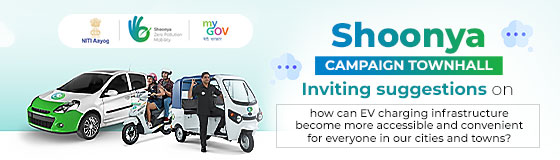
Shoonya Campaign Townhall - Inviting Suggestions on how can EV charging infrastructure become more accessible and convenient for everyone in our cities and towns

Start Date :
Jan 16, 2024
Last Date :
Feb 16, 2024
23:45 PM IST (GMT +5.30 Hrs)
The NITI Aayog-led Shoonya campaign, in partnership with MyGov India, is thrilled to announce the electric vehicles Townhall, an open discussion platform for citizens to share ...
All Comments
Featured
New Comments
Showing 435 Submission(s)
Sakthivel
2 years 5 months ago
Although the adoption of the electricity vehicles industry in India is still at a nascent stage in India, it is rapidly growing. As per the data provided by the Ministry of Road Transport and Highways, Government of India, to the Parliament in 2013, only 53,387 electric vehicles were registered in the country however, as of August 2023, the number increased to 28,30,565.
The latest Economic Survey underlines that India’s automotive industry will play a critical role in the transition towards green energy. It is estimated that the country’s EV market is expected to grow at a compound annual growth rate (CAGR) of 49% between 2022 and 2030 and that the annual sales of EVs in 2030 may cross one crore units, leading to the creation of five crore direct and indirect jobs by 2030.
Like
(12)
Dislike
(2)
Reply
Report Spam

Sakthivel
2 years 5 months ago
It is worth mentioning that the first electric vehicles were developed in the early 19th century when, in 1832, Scottish inventor Robert Anderson invented the first crude electric carriage. However, it wasn’t until the second half of the 19th century that some of the first practical electric cars were built.
As the EVs were easier to drive than steam-powered and gasoline-powered cars, in the latter half of the 19th century, the EVs acquired popularity in the United States for driving in the city. However, due to multiple factors like better roads, the discovery of Texas crude oil, lower fuel prices, better combustion engines, Ford’s mass production of cheaper vehicles and other factors, the use of EVs started to decline in the 1920s. Due to the soaring oil prices in the 1960s and environmental concerns after the 1990s, EVs evinced interest from researchers, policymakers, and the public.
Like
(12)
Dislike
(2)
Reply
Report Spam
Sakthivel
2 years 5 months ago
The Indian government has defined public charging stations and EV charging businesses as de-licensed activity.[12][13] It has been specified that each 3-by-3-kilometre (1.9 by 1.9 mi) area in cities must have at least one charging station, and one station every 25 kilometres (16 mi) on both sides of highways. These guidelines were mandated in cities with populations of over four million and all expressways and major highways connecting those cities by 2022. The second phase (three to five years) will focus on large cities, such as state capitals and Union Territory headquarters.[14] Plugin India is an initiative to facilitate community charging stations,[15] and solar-powered charging points at fuel stations are planned.[16][17][18] Companies such as Tata Power, Fortum and Joulepoint are part of the electric-vehicle-charging sector. They have installed a variety of chargers, including rapid DC chargers and level 2 AC chargers, for applications such as public access, workplace charging,
Like
(11)
Dislike
(2)
Reply
Report Spam
Sakthivel
2 years 5 months ago
The electric vehicle industry in India is slowly growing. The central and state governments have implemented schemes and incentives to promote electric mobility, and have introduced regulations and standards. Although India would benefit from converting its transport from internal combustion (IC) engines to electric motors, challenges include a lack of charging infrastructure, high initial cost and a lack of renewable energy. E-commerce companies, car manufacturers, app-based transport network companies and mobility-solution providers have entered the sector, however, and are slowly building electric-car capacity and visibility.
Like
(11)
Dislike
(2)
Reply
Report Spam
Sakthivel
2 years 5 months ago
The Shoonya campaign aims to reduce air pollution in India by accelerating the adoption of electric vehicles for last-mile delivery.
Like
(11)
Dislike
(3)
Reply
Report Spam
Mamta sipahimalani
2 years 5 months ago
the integration of smart technology for efficient energy management, remote monitoring of charging stations, and real-time data analytics for better planning.
Like
(11)
Dislike
(2)
Reply
Report Spam
MARULRAJ
2 years 5 months ago
solar ev energy + flash charging = Super Sonic
Like
(12)
Dislike
(2)
Reply
Report Spam
MARULRAJ
2 years 5 months ago
defence helicopter ko b super sonic me upgrade karna chahiye koi countries abhi tak start nhi Kiya hai experiment kar rahe hai defence aircraft ke liye india ko jaldi kaam karna chahiye ispar supar sonic sirf defence me hi nhi VAHICLES me b karna chahiye future end yahi jakar khatam hoga
Like
(12)
Dislike
(2)
Reply
Report Spam
ALI HAIDAR NAQVI
2 years 5 months ago
Jai Hind Jai Bharat
Like
(8)
Dislike
(3)
Reply
Report Spam
MARULRAJ
2 years 5 months ago
ev VAHICLES me b supar sonic ke upar kaam karna chahiye kyuki saare countries kuch banane ke baad hi india b banati isse accha hai ki Jo dimaag me aata hai usme experiment karna chahiye motorvahichle industries me revoluation global list me laana hai toh super sonic VAHICLE ke liye b kaam karna hoga india agar isme success HOJAYGA toh india top me rahega
Like
(12)
Dislike
(2)
Reply
Report Spam
- View More