Home | MyGov

Accessibility
Accessibility Tools
Color Adjustment
Text Size
Navigation Adjustment
Screen Reader iconScreen Reader

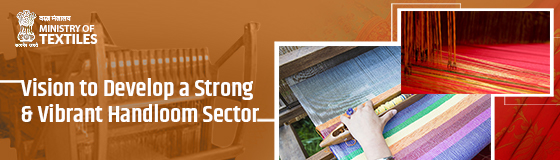
Vision to develop a Strong & Vibrant Handloom Sector

Start Date :
Mar 03, 2020
Last Date :
Jun 03, 2020
23:45 PM IST (GMT +5.30 Hrs)
Submission Closed

The O/o Development Commissioner (Handlooms), Ministry of Textiles, Government of India (GoI), is working for development of Handloom Sector with a vision to develop a strong, ...

The O/o Development Commissioner (Handlooms), Ministry of Textiles, Government of India (GoI), is working for development of Handloom Sector with a vision to develop a strong, vibrant Handloom Sector to provide sustainable employment to Handloom weavers. The overall goal of this office can be understood by following points:

Mission
To make the Handloom sector self sustainable for inclusive growth.
Empowerment of the weavers through technological upgradation.
Focused, flexible and holistic approach to meet the challenges of domestic and global market.
Brand building in global and domestic markets.
Easy access to raw material at reasonable prices.

Objective
To ensure overall development of the Handloom, including welfare of handloom weavers.
To provide new upgraded looms and accessories to handloom weavers.
To provide subsidized yarn in the clusters areas.
Market orientation by associating entrepreneurs, designers, and professionals for marketing, designing and managing the production.
To facilitate process of credit from financial institutions/banks.

Functions
To develop the handloom clusters and empower the weavers with a provision of new looms, CFC, Yarn Depot, buyer–seller meet.
To set up Yarn Depots to provide easy access to quality yarns at subsidized rates to be set up in the HL clusters.
To provide credit facility at low interest rates for production and marketing activities.
Developing capacity for developing fashion and market directed design and products.
Developing market for Handloom products by creating strong brand and involving private sector in marketing and export.

Handloom Craft Village (New Activity) recently started.

For integrated sustainable development of handloom with tourism & culture, this is a new initiative of this office with the help of State Governments concerned. 5 villages are being developed as “Tourist handloom village” are as under:
1. Sharan, Distt. Kullu, Himachal Pradesh
2. Kanihama, Budgam, Srinagar
3. Rampur, Bodh Gaya, Bihar
4. Borjuri, Golaghat, Assam
5. Kovalam, Thiruanathpuram, Kerala

Award to Handloom Weavers:
To encourage the Handloom weavers who are doing extraordinary job by producing unique products on handloom, this office is conferring Sant Kabir Award, National Award and National Merit Certificates. These Awards are being conferred every year by this office. These Awards encourage the individual weavers to develop & produce products of high quality. Preference is also being given in several marketing activities like expos being organised at International, National and Regional levels. The last date for inviting application for “Year-2018” has been extended to 21st March, 2020. Interested applicants may forward their entries through this forum by providing their basic details in the application form provided, so that our field offices (Weavers Service Centres) team may contact applicant for further assistance.

The purpose of this white-paper is to solicit public inputs for ongoing activities of this office as well as new thoughts/ideas and inputs. We would like to adopt a participatory process to prepare this strategy and seek perspectives from a broad spectrum of stakeholders including government officials in the Centre and the States, policy researchers, entrepreneurs, technology developers, as well as Civil Society.

The last date for submissions on this forum is 3rd June, 2020.
Reset
Showing 2465 Submission(s)
Rajya Lakshmi Chevuru
Rajya Lakshmi Chevuru 6 years 4 months ago
We all know that linen is one of the best fabrics to wear during the summer. It's light, it's breathable, and that helps to keep you cool. However, more than any other fabric, linen loves to wrinkle. ... But to be honest, those very wrinkles make up some of the charm of wearing linen clothing.
Rajya Lakshmi Chevuru
Rajya Lakshmi Chevuru 6 years 4 months ago
Pure linen is a textile made from the fibers of the flax (linseed) plant. Despite being an ancient fabric, pure linen, remains forever young with it's popularity growing each year. The secret lies in the unique and exceptional qualities of the pure linen fabric, making it the most superior of all textiles.
Rajya Lakshmi Chevuru
Rajya Lakshmi Chevuru 6 years 4 months ago
Today, linen is a popular Indian saree because of its durability as well as breathability. Linen fabric is extracted from the flax plant. This is expensive than cotton and a better heat conductor. Linen saree is very lightweight and easily washable.
Rajya Lakshmi Chevuru
Rajya Lakshmi Chevuru 6 years 4 months ago
warp or weft based saree– linen is warp-based saree. ... “we can use called linen by cotton or linen by silk or linen by khadi. Linen is breathable but has the tendency to be stiff. so When linen is combined with cotton, khadi,and silk the saree is become softer.
Rajya Lakshmi Chevuru
Rajya Lakshmi Chevuru 6 years 4 months ago
Linen becomes softer and more absorbent after each wash, which is pretty neat. Wash linen on low temperatures in lukewarm or cold, and preferably soft, water. Use the gentle machine cycle and a mild detergent to protect the fibres. Again, read the individual manufacturer's care instructions to be sure.
Rajya Lakshmi Chevuru
Rajya Lakshmi Chevuru 6 years 4 months ago
Steps Moisten the end of a finger with water. Place this finger onto the fabric and press. Check the other side straight away. If the moisture comes through the fabric immediately, it's linen. If the moisture is slower to come through, it'll be another fabric.
Rajya Lakshmi Chevuru
Rajya Lakshmi Chevuru 6 years 4 months ago
Linen is the oldest fabric known to man. A saree is a female garment that originated in India. It consists of a length of fabric that measures between 5 and 9 yards long and is 2 to 4 feet wide. It is worn wrapped around the body in a specific way.
Rajya Lakshmi Chevuru
Rajya Lakshmi Chevuru 6 years 4 months ago
Linen saree is made out of linen fabric. Linen is a type of (natural) fabric made out of flax fibre/yarn. It can be called natural, based on its plant (non-synthetic) origin.
Rajya Lakshmi Chevuru
Rajya Lakshmi Chevuru 6 years 4 months ago
Three types of weaves: plain, twill, and satin. Encyclopædia Britannica, Inc. The manner in which the yarns are interlaced determines the type of weave. The yarn count and number of warp and filling yarns to the square inch determine the closeness or looseness of a weave.
Rajya Lakshmi Chevuru
Rajya Lakshmi Chevuru 6 years 4 months ago
A drawloom is a frame which sits on the top of your loom. It adds a second harness of shafts called pattern shafts. These give you pattern capability beyond what you can get with any other type of loom, more pattern capability than you can get with a computer operated loom.