Home | MyGov

Accessibility
Accessibility Tools
Color Adjustment
Text Size
Navigation Adjustment
Screen Reader iconScreen Reader

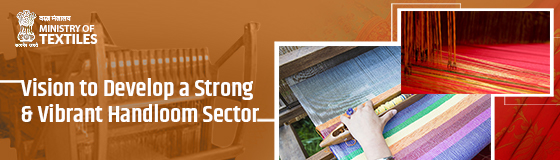
Vision to develop a Strong & Vibrant Handloom Sector

Start Date :
Mar 03, 2020
Last Date :
Jun 03, 2020
23:45 PM IST (GMT +5.30 Hrs)
Submission Closed

The O/o Development Commissioner (Handlooms), Ministry of Textiles, Government of India (GoI), is working for development of Handloom Sector with a vision to develop a strong, ...

The O/o Development Commissioner (Handlooms), Ministry of Textiles, Government of India (GoI), is working for development of Handloom Sector with a vision to develop a strong, vibrant Handloom Sector to provide sustainable employment to Handloom weavers. The overall goal of this office can be understood by following points:

Mission
To make the Handloom sector self sustainable for inclusive growth.
Empowerment of the weavers through technological upgradation.
Focused, flexible and holistic approach to meet the challenges of domestic and global market.
Brand building in global and domestic markets.
Easy access to raw material at reasonable prices.

Objective
To ensure overall development of the Handloom, including welfare of handloom weavers.
To provide new upgraded looms and accessories to handloom weavers.
To provide subsidized yarn in the clusters areas.
Market orientation by associating entrepreneurs, designers, and professionals for marketing, designing and managing the production.
To facilitate process of credit from financial institutions/banks.

Functions
To develop the handloom clusters and empower the weavers with a provision of new looms, CFC, Yarn Depot, buyer–seller meet.
To set up Yarn Depots to provide easy access to quality yarns at subsidized rates to be set up in the HL clusters.
To provide credit facility at low interest rates for production and marketing activities.
Developing capacity for developing fashion and market directed design and products.
Developing market for Handloom products by creating strong brand and involving private sector in marketing and export.

Handloom Craft Village (New Activity) recently started.

For integrated sustainable development of handloom with tourism & culture, this is a new initiative of this office with the help of State Governments concerned. 5 villages are being developed as “Tourist handloom village” are as under:
1. Sharan, Distt. Kullu, Himachal Pradesh
2. Kanihama, Budgam, Srinagar
3. Rampur, Bodh Gaya, Bihar
4. Borjuri, Golaghat, Assam
5. Kovalam, Thiruanathpuram, Kerala

Award to Handloom Weavers:
To encourage the Handloom weavers who are doing extraordinary job by producing unique products on handloom, this office is conferring Sant Kabir Award, National Award and National Merit Certificates. These Awards are being conferred every year by this office. These Awards encourage the individual weavers to develop & produce products of high quality. Preference is also being given in several marketing activities like expos being organised at International, National and Regional levels. The last date for inviting application for “Year-2018” has been extended to 21st March, 2020. Interested applicants may forward their entries through this forum by providing their basic details in the application form provided, so that our field offices (Weavers Service Centres) team may contact applicant for further assistance.

The purpose of this white-paper is to solicit public inputs for ongoing activities of this office as well as new thoughts/ideas and inputs. We would like to adopt a participatory process to prepare this strategy and seek perspectives from a broad spectrum of stakeholders including government officials in the Centre and the States, policy researchers, entrepreneurs, technology developers, as well as Civil Society.

The last date for submissions on this forum is 3rd June, 2020.

Reset
Showing 2465 Submission(s)
Bisathi Bharath
Bisathi Bharath 6 years 4 months ago
From a social transformation perspective, apparel generate large number of jobs for women, substantially more than in any other sector. In Bangladesh, female education, total fertility rates, and women’s labour force participation moved positively due to the expansion of the apparel sector. India’s low and declining female labour force participation could be similarly boosted by this initiative.
Bisathi Bharath
Bisathi Bharath 6 years 4 months ago
EMPLOYMENT GENERATOR India needs to generate jobs that are formal and productive, provide bang-for-buck in terms of jobs created relative to investment, have the potential for broader social transformation, and can generate exports and growth. The apparel (or garment) sector meets all these criteria, making it an excellent vehicle for an employment creation strategy.
Bisathi Bharath
Bisathi Bharath 6 years 4 months ago
The production of raw cotton in India is estimated to have reached 36.1 million bales in FY19 The close linkage of the textile industry to agriculture (for raw materials such as cotton) and the ancient culture and traditions of the country in terms of textiles make the Indian textiles sector unique in comparison to the industries of other countries.
Bisathi Bharath
Bisathi Bharath 6 years 4 months ago
Currently estimated at around US$ 150 billion, is expected to reach US$ 250 billion by 2019. The sector contributed 7% of the industry output (in value terms) of India in 2017-18 2% to the GDP of India and employed more than 45 million people in 2017-18 15% to the export earnings of India in 2017-18
Bisathi Bharath
Bisathi Bharath 6 years 4 months ago
Credit Availability In order to provide financial assistance, the Government of India has launched new schemes such as Deen Dayal Hathkargha Protsahan Yojana and some others. These are vital in solving the problems of handloom industry in India. Along with the artistry of weavers, the Indian handloom industry demonstrates the richness and diversity of the Indian culture. Support at every level is vital for untrapping the massive potential of this ancient industry
Bisathi Bharath
Bisathi Bharath 6 years 4 months ago
Raw Material Supply and Design Development: Support is being provided to resolve the hank yarn access issue. Help is also being provided to weavers for upgrading their skills and essential inputs are being offered for better quality and design management.
Bisathi Bharath
Bisathi Bharath 6 years 4 months ago
Better Organization: Concerted efforts are being made to enhance production, infrastructure, productivity, and efficiency as well as enhance the income and socio-economic status of the weavers.
Bisathi Bharath
Bisathi Bharath 6 years 4 months ago
Credit Needs The credit facilities available to weavers are often much less than satisfactory. Loan offering financial institutions/banks are not many and have lengthy and complicated procedures of availing the same. The problems of handloom industry in India are well pronounced.
Bisathi Bharath
Bisathi Bharath 6 years 4 months ago
Lack of product diversification and problems with yarn procurement Non-availability of sufficient yarn in the form of hanks and the conservative attitude of the weavers, coupled with their ignorance about current fashion and market trends results in insufficient diversification of products.
Bisathi Bharath
Bisathi Bharath 6 years 4 months ago
Problems of handloom industry in India #1 Disorders of an unorganized sector Primarily a household industry, the weavers are unorganized and there is a lack the necessary financial support and infrastructure. In addition to this, the production pattern is mostly dispersed and decentralized and there are no marketing strategies in place, unlike in a cooperative sector. This stagnates growth.