Home | MyGov

Accessibility
ऐक्सेसिबिलिटी टूल
कलर एडजस्टमेंट
टेक्स्ट साइज़
नेविगेशन एडजस्टमेंट

हमारे पारंपरिक ज्ञान और पद्धति के विषय में समाज में विश्वास पैदा करने के लिए अपने विचार साझा करें

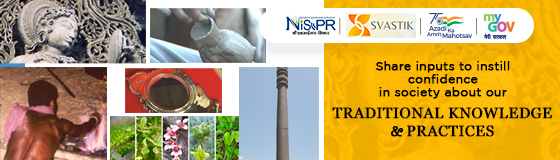
Share inputs to instil confidence in society about our traditional knowledge and practices
आरंभ करने की तिथि :
Mar 03, 2022
अंतिम तिथि :
Aug 31, 2022
23:45 PM IST (GMT +5.30 Hrs)
प्रस्तुतियाँ समाप्त हो चुके

भारत में जीवन के विभिन्न पहलुओं से जुड़ी प्रथाओं/पद्धतियों और ज्ञान ...

भारत में जीवन के विभिन्न पहलुओं से जुड़ी प्रथाओं/पद्धतियों और ज्ञान के साथ-साथ विज्ञान और प्रौद्योगिकी (एस एंड टी) के विभिन्न क्षेत्रों से जुड़ी एक समृद्ध वैज्ञानिक विरासत है। भारत का पारंपरिक ज्ञान विभिन्न रूपों में उपलब्ध है जैसे कि शास्त्रीय ग्रंथ, पांडुलिपियां और/या मौखिक संचार के रूप में जो कि हजारों वर्षों से चला आ रहा है। यह बहुमूल्य ज्ञान अक्सर हमारे दैनिक क्रिया-कलापों का भी हिस्सा है। कुछ पारंपरिक पद्धतियों से संबंधित ज्ञान धारकों की आजीविका के साधन हैं। हमारी पारंपरिक पद्धतियां मनुष्य की आवश्यकताओं और प्रकृति के बीच तालमेल बनाये हैं जो कि अक्सर स्थानीय संदर्भ में मनुष्य के संसाधनों और आवश्यकताओं में संतुलन बनाये रखती हैं। हालाँकि, समय के साथ, भारत की पारंपरिक ज्ञान प्रणालियाँ तेजी से नष्ट हो रही हैं, और हमारा राष्ट्र हमारे पारंपरिक ज्ञान के प्रति लोगों के विश्वास में गिरावट भी देख रहा है। गैर-भारतीय संस्कृतियों की नकल करने और हमारी परंपराओं का तिरस्कार करने के लिए कुछ लोगों का नासमझ रवैया एक गंभीर चिंता का विषय है। यह पहचानना महत्वपूर्ण है कि पारंपरिक विरासत किसी भी देश के विकास और प्रगति का एक अभिन्न अंग है। यह आवश्यक है कि देश में हमारी वैज्ञानिक विरासत की एक मजबूत आधारशिला बनाने हेतु संबंधित हितधारक आगे आयें। एक जागरूक और संतुलित समाज ही देश को आगे बढ़ा सकता है।

हमारे माननीय प्रधान मंत्री और सीएसआईआर सोसाइटी के अध्यक्ष, श्री नरेंद्र मोदी जी के नेतृत्व में, वैज्ञानिक तथा औद्योगिक अनुसंधान परिषद (सीएसआईआर) देश भर से पारंपरिक ज्ञान संबंधित भागीदारों के साथ सहयोग करने और इस राष्ट्रीय पहल को लागू करने के प्रयासों का नेतृत्व कर रहा है। भारत के पारंपरिक ज्ञान को समाज तक पहुँचाने के लिए सीएसआईआर-राष्ट्रीय विज्ञान संचार एवं नीति अनुसंधान संस्थान (सीएसआईआर-निस्पर) इस राष्ट्रीय पहल “स्वस्तिक-वैज्ञानिक रूप से मान्य सामाजिक पारंपरिक ज्ञान” को लागू करने वाला नोडल संस्थान है।

इस पहल का मुख्य उद्देश्य वैज्ञानिक रूप से मान्य पारंपरिक पद्धति/कार्यप्रणाली का संरक्षण करना और साथ ही हमारे पारंपरिक ज्ञान/पद्धति के वैज्ञानिक मूल्यों के बारे में समाज में विश्वास पैदा करना है

हम अपने पारंपरिक ज्ञान और पद्धतियों के विषय में समाज में विश्वास कैसे पैदा करें, इस पर शिक्षाविदों, शोधकर्ताओं, विषय-विशेषज्ञों, छात्रों, गैर-सरकारी संगठनों और जनता के सुझावों को हम आमंत्रित करते हैं। यह हमारे पारंपरिक ज्ञान और पद्धतियों के प्रति विज्ञान-वैज्ञानिक-समाज के जुड़ाव को प्रोत्साहित करके वैज्ञानिक सोच विकसित करने और समाज में विश्वास पैदा करने के हमारे उद्देश्य को पूरा करने में हमारी मदद करेगा।

सीएसआईआर-निस्पर की स्वस्तिक पहल के विषय में अधिक जानकारी के लिए यहां क्लिक करें।यहां क्लिक करें। (PDF 1519 KB)

या इस वेबसाइट पर जाएं -https://niscpr.res.in/nationalmission/svastik

आप अपने पारम्परिक ज्ञान तथा कार्य कार्यप्रणाली के बारे कितना जानते हैं? MyGov प्रश्नोत्तरी प्रतियोगिता में भाग लें और भारत के पारम्परिक ज्ञान के बारे में अपने ज्ञान को परखें। Quiz Link: https://quiz.mygov.in/quiz/quiz-on-indian-traditional-knowledge/

अपने विचार और सुझाव साझा करने की अंतिम तिथि: 31 अगस्त 2022

फिर से कायम कर देना
2022 सबमिशन दिखा रहा है
Prapti Sharma
Prapti Sharma 3 साल 10 महीने पहले
There will be no exaggeration if we say that Indian culture is the storehouse of all human qualities because Indian culture believes in the mantra 'SarveBhavantuSukhinah’ (Brihadaranyaka Upanishad) meaning may all become happy and from this arises a great welfare mantra of 'Vasudev Kutumbakam'(Maha Upanishad 6.71-75) meaning the whole world is one single family. India is a land of culture, tradition, and customs. Indian traditions and culture are known universally. Culture describes all the mental processes that are (or can be) subject to social transmission, as well as other elements of human behavior that help to establish and form our mental processes. Our heritage is so rich that the whole world is attracted by our customs. We have been following our customs and tradition since ages and science is embedded in these traditions and customs. Countless rituals and traditions have been performed in Indian homes for centuries.
Prapti Sharma
Prapti Sharma 3 साल 10 महीने पहले
The division of distinction that separates art and culture from science is artificial. In ancient times, all the innovative thoughts and postulates of great sages fell under the overall umbrella of philosophy. There was no division between scientific and religious thinking in those days, all innovators being regarded as philosophers or rishis. They did not necessarily speak of religion alone. They had a deep insight or Antar Drishti. Their invaluable contributions to Astronomy are an inseparable part of the holy Rig Veda. Similarly, the Samhitas and the Atharva Veda, respectively, are the repositories of important treatises on medicine and mathematics. Culture is thus inseparable from science, and vice versa. 'Nahijananenasadrsam', or there is nothing that bears comparison to knowledge, epitomizes the homage of Indian culture to learning and inspired our ancients' quest for knowledge. Science was an integral part and an important preoccupation in ancient Indian culture.
Prapti Sharma
Prapti Sharma 3 साल 10 महीने पहले
Traditional knowledge typically distinguishes one community from another. In some communities, traditional knowledge takes on personal and spiritual meanings. Traditional knowledge can also reflect a community's interests. Some communities depend on their traditional knowledge for survival. Traditional knowledge regarding the environment, such as taboos, proverbs and cosmological knowledge systems, may provide a conservation ethos for biodiversity preservation. This is particularly true of traditional environmental knowledge, which refers to a "particular form of place-based knowledge of the diversity and interactions among plant and animal species, landforms, watercourses, and other qualities of the biophysical environment in a given place".Some social scientists conceptualise knowledge within a naturalistic framework and emphasize the gradation of recent knowledge into knowledge acquired over many generations. These accounts use terms like adaptively acquired knowledge, socially cons
Prapti Sharma
Prapti Sharma 3 साल 10 महीने पहले
Traditional knowledge includes types of knowledge about traditional technologies of subsistence (e.g. tools and techniques for hunting or agriculture), midwifery, ethnobotany and ecological knowledge, traditional medicine, celestial navigation, craft skills, ethnoastronomy, climate, and others. Traditional knowledge (TK), indigenous knowledge (IK) and local knowledge generally refer to knowledge systems embedded in the cultural traditions of regional, indigenous, or local communities. According to the World Intellectual Property Organization (WIPO) and the United Nations (UN), traditional knowledge and traditional cultural expressions (TCE) are both types of indigenous knowledge. In many cases, traditional knowledge has been passed for generations from person to person, as an oral tradition. Some forms of traditional knowledge find expression in culture, stories, legends, folklore, rituals, songs, and laws, languages, songs, dance, games, mythology, designs, visual art and archtechture
Prapti Sharma
Prapti Sharma 3 साल 10 महीने पहले
The Indigenous Knowledge Systems and Practices (IKSPs) have been proven to contribute to the sustainability and productivity of many ecosystems, examples of which include the rice terraces and imuyung (private woodlot of the Ifugao, the traditional biodiverse swidden of the Hanunuo, the fish conservation practices of the Dumagat, and the traditional herbal medicines of many Filipino ethnic communities. Undoubtedly, the indigenous peoples communities have made courageous efforts to protect their IKSPs, but with the rapid development around them and subsequent massive degradation of natural resources, those efforts are not enough. Their local initiatives need to be recognized, enhanced and supported by the government.
Pramod  tripathi
Pramod tripathi 3 साल 10 महीने पहले
भारत बिबिधताओ का देश है जहाँ प्रति 40 किलोमीतर् के बाद भाषा और रीति रिवाज बदल जाते है फिर भी देश या अविस्कार् की आवस्यकता पड़ने पर सम्पूर्ण भारत बिबिधता को छोड़ कर एक जुट हो जाता है
arti
arti 3 साल 10 महीने पहले
MananniyenPradhanmantri ji namaskar traditional knowledge and practices ke liye mai khna chahungi ki jo log fasting rakhte hai us din mitti ke bne pot se apna food bnaye. Diwali me mitti se bane diya ko hi jalaye. Bihar me bhut dhum dham se chat festival mnaya jata hai jisme phle sirf raw materials hi use hota tha jaise Bamboo se bna daliya,mitti se bna pot,ajkal metal se bna pot sab use hone laga hai. Bhut women hai jo bedsheets,sweaters, curtains,table cloths,khud bna sakti hai lekin ajkal bnane se jyada jor kharidne pe dia ja rha kyuki unki value society me nhi ki jati hai.Daily uses cloths bhi khud bnakar phnane se jyada jor kharidne pe dia jata hai kyuki isase log modern feel karte hai