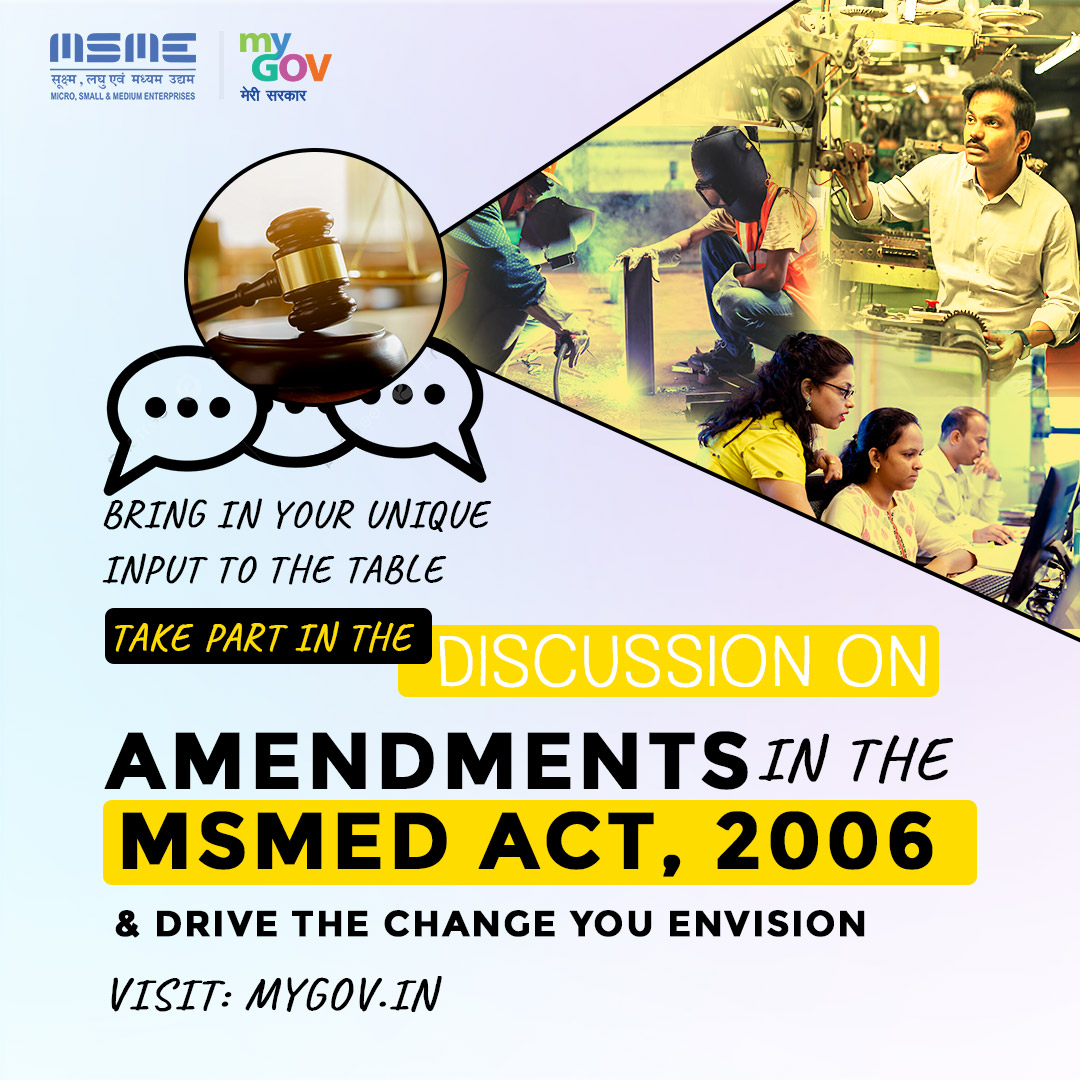
The Ministry of MSME is in the process of amending the MSMED Act, 2006. In this regard, this Ministry had consulted various central Ministries/Department/State Govt./Industry Associations/other stakeholders & general public.
Based on the consultations and written inputs received from various stakeholders, the amendments proposed in the MSMED Act, 2006 are based on the following four key pillars:
A) Enhancing inclusivity and broad-basing the scope of the Act;
B) Future-proofing the Act;
C) Improving co-ordination under the Act;
D) Enhancing the ease of business in the ecosystem;
A) Enhancing Inclusivity and Broad-basing the scope of the Act
• Accord statutory status to Udyam registration for availing benefits under the Act.
• Provision for credit guarantee coverage to Micro and Small Enterprises by Government.
• Enabling provisions to address issues of credit gap; shortage of working capital; ensure adequate, affordable, and timely finance to enterprises; minimize the incidence of financial stress among enterprises; and leverage new and emerging platforms and technologies such as the Trade Receivables Discounting System, Account Aggregator Framework, etc.
• Provision for targeted mechanisms for capacity building of women, members of SC and ST, and rural artisans and craftspeople and provisions for market access, financial and digital literacy.
• Inclusion of cottage, village, and coir industries as rural artisans and craftspeople in the MSME classification scheme, to promote rural industries and enterprises.
• Inclusion of Medium Enterprises in the dispute resolution framework
B) Future-proofing the Act
• Strengthen provisions for technological upgradation and green technology to enhance productivity, quality, and competitiveness.
• Enabling provisions for the adoption of energy-efficient, sustainable technologies by MSME.
• Designation of a Green Fund to support the energy transition of MSME and integration in the global value chain.
• Addressing industrial obsolescence among enterprises.
• Promoting technological upgradation and research and development among enterprises.
• Encouraging the adoption of sustainable technology solutions by enterprises.
C) Improving coordination
• Streamline the structure, working, and functions of the National Board and the Advisory Committee to make them lean, efficient, and responsive to the requirements of MSME, and strengthen the monitoring and evaluation mechanism.
• Provision to set up an adequate number of Facilitation Councils in States for better access to MSMEs, along with an incentive structure to promote competition and good performance among them.
• The composition of the Facilitation Councils may be prescribed by the State Government.
D) Enhancing Ease of Business in the Ecosystem
• Provisions for the decriminalisation of offences by converting criminal fines into civil penalties.
• Simplification of regulatory clearance mechanism and procedure for establishment and management of MSME by making suitable provisions in the Rulemaking powers of the appropriate Government.
• Creating and encouraging the adoption of digital solutions to improve transparency and foster a culture of accountability
• Make the adjudication process simpler and speedier, aligning it with the alternative dispute resolution framework and online dispute redressal.
Please Click Here to Read more.